


Quality & Measurement Standards
Quantity and quality disputes are settled by standards, not by opinion. These are the standards we work to when we store, measure, sample and release product.

A barrel on a storage receipt is a calculated figure. It starts as a gauge reading and a temperature, is corrected to standard conditions, has sediment and water deducted, and is checked against an independent inspector's figures. Each of those steps is defined by a published standard, and the standards are what make the number defensible.
We work to the standards our customers name in their contracts: the API Manual of Petroleum Measurement Standards (MPMS) for quantity, API tank standards for the equipment, and ASTM and ISO methods for quality. We do not display certification marks on this site. Where certificates are held for a site or activity, we provide copies to verified counterparties on request.
Quantity: API MPMS
Tank quantities are determined to the API Manual of Petroleum Measurement Standards. Opening and closing gauges, by innage (depth of liquid) or ullage (empty space above it), are taken with the product settled, free water is measured at the tank bottom, and temperatures are taken at the levels the standard sets. The result is corrected to standard conditions and reported as gross and net standard volume.
Meter-based transfers at pipeline connections and truck racks use meters and provers to Chapters 4, 5 and 6, and marine figures are compared with vessel figures adjusted by the vessel experience factor under Chapter 17, so shore and ship quantities can be reconciled on every parcel.
| API MPMS chapter | What it covers |
|---|---|
| Chapter 2 | Tank calibration and capacity tables |
| Chapter 3 | Tank gauging, manual and automatic (ATG) |
| Chapter 7 | Temperature determination |
| Chapter 8 | Sampling, manual and automatic |
| Chapter 10 | Sediment and water |
| Chapter 11.1 | Volume correction for temperature and pressure |
| Chapter 12 | Calculation of petroleum quantities |
| Chapter 17 | Marine measurement |
Equipment: API 650, 653 and 2350
The tank is part of the measurement. API Standard 650 governs the design and construction of welded atmospheric storage tanks, and API 653 governs their inspection, repair, alteration and reconstruction in service, including the settlement and shell-roundness checks that affect a tank's calibration. Where repair work changes a tank's volume, it is re-calibrated before it returns to custody service.
API Standard 2350 sets our overfill-prevention framework. It matters to quality as well as safety: a receipt planned against documented working levels is a receipt that never needs a rushed diversion into a tank nobody planned for, and never mixes grades in the process.
Quality: ASTM and ISO test methods
Quality is tested to the method the contract or specification names: usually ASTM methods in US trade and ISO or EN methods elsewhere. Marine fuels are tested against ISO 8217:2024, the current edition of the marine fuel specification, which added requirements for fuels containing bio-components. Jet fuel follows ASTM D1655 or the buyer's specification, diesel ASTM D975 and gasoline ASTM D4814.
| Property | Typical ASTM method |
|---|---|
| Density | D1298 (hydrometer) or D4052 (digital meter) |
| Distillation | D86 |
| Flash point | D93 (Pensky-Martens) or D56 (Tag) |
| Sulfur | D4294, D2622 or D5453 |
| Kinematic viscosity | D445 |
| Water and sediment | D4007, D2709 or D4928 |
| Vapor pressure | D5191 |
| Thermal stability (jet fuel) | D3241 |
Independent inspection
Most cargoes we store or move are measured and sampled by an independent inspection company appointed by the parties under their contract. We give the inspector access to gauge points, sample connections and records, and our operators witness the work. The inspector's certificates of quantity and quality are the documents a sale contract normally relies on.
Our own figures are reconciled with the inspector's at every receipt and delivery. Where they differ by more than the contract allows, we investigate before the stock record closes: re-gauging, checking temperatures and the calibration table, reviewing line-fill, and re-testing retained samples where quality is in question.
- Retained samples sealed, labeled and kept for the period the contract specifies
- Line-fill status recorded before and after each transfer
- Quality disputes settled on test-method reproducibility under ISO 4259 or ASTM D3244
- Joint inspection where buyer and seller each appoint a surveyor
Certificates and audits
We describe the standards we work to rather than display certification marks. Where a management-system, sustainability-scheme or calibration certificate is held for a particular site or instrument, we provide a copy to verified counterparties on request, with its scope and issuing body, so it can be checked with the issuer. A certificate offered to anyone who has not passed our KYC did not come from us.
Standards we work to

ISO and American Petroleum Institute (API) standards for measurement, tank equipment and product quality, and the ISCC scheme for renewable and sustainable feedstocks.
Frequently asked questions
Do you use automatic or manual gauging for custody transfer?
Both are recognized under API MPMS Chapter 3. An automatic tank gauge used for custody transfer must meet that chapter's accuracy and verification requirements. Manual gauging remains the reference, and independent inspectors normally gauge manually at opening and closing.
Which reference temperature do you use?
60 °F for US-traded volumes and 15 °C where the contract specifies metric standard conditions. Volume correction uses API MPMS Chapter 11.1 or the equivalent the contract names, and the reference basis is stated on every quantity document.
Can we appoint our own inspector?
Yes. Buyers and sellers usually appoint an independent inspection company under their contract, often jointly. We give the appointed inspector access to tanks, sampling points and records, and coordinate timing with the transfer.
What happens if your figures and the inspector's differ?
We investigate before closing the stock record: re-gauging, checking temperatures, the calibration table, line-fill and vessel experience factors, and re-testing retained samples if quality is in question. The outcome is documented and shared with the parties to the transfer.
Related
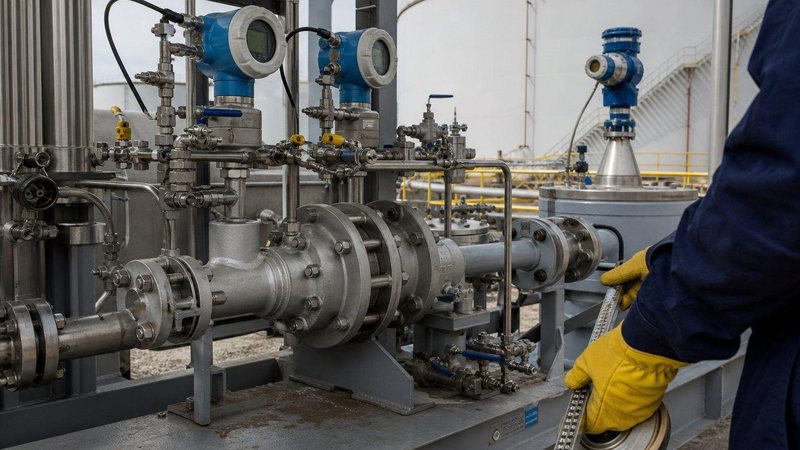
Custody Transfer Measurement
Tank gauging, meters and provers, sampling and volume correction to API MPMS standards.
Read more
Tank Gauging: Reading the Numbers
Innage, ullage, ATG and manual gauges, and a worked opening and closing gauge report.
Read more
Fuel Quality Specifications
ISO 8217, ASTM D975 and D1655, EN 590 and EN 14214: which spec governs which fuel.
Read more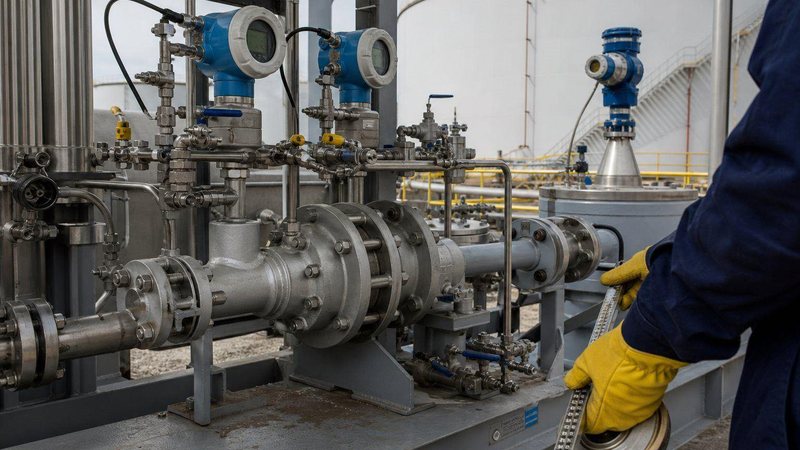
Custody Transfer, Explained
From TOV to NSV to metric tons: the quantity chain behind every invoice, with a worked example.
Read moreNeed a quantity or quality record explained?
Verified customers can request gauge tickets, inspector reports and test certificates for their stock.