


Glossary of Terminal and Freight Terms
Short, exact definitions of the terms used on gauge reports, charter parties, storage agreements and certificates of quality, including words that also appear in oil-trade fraud.
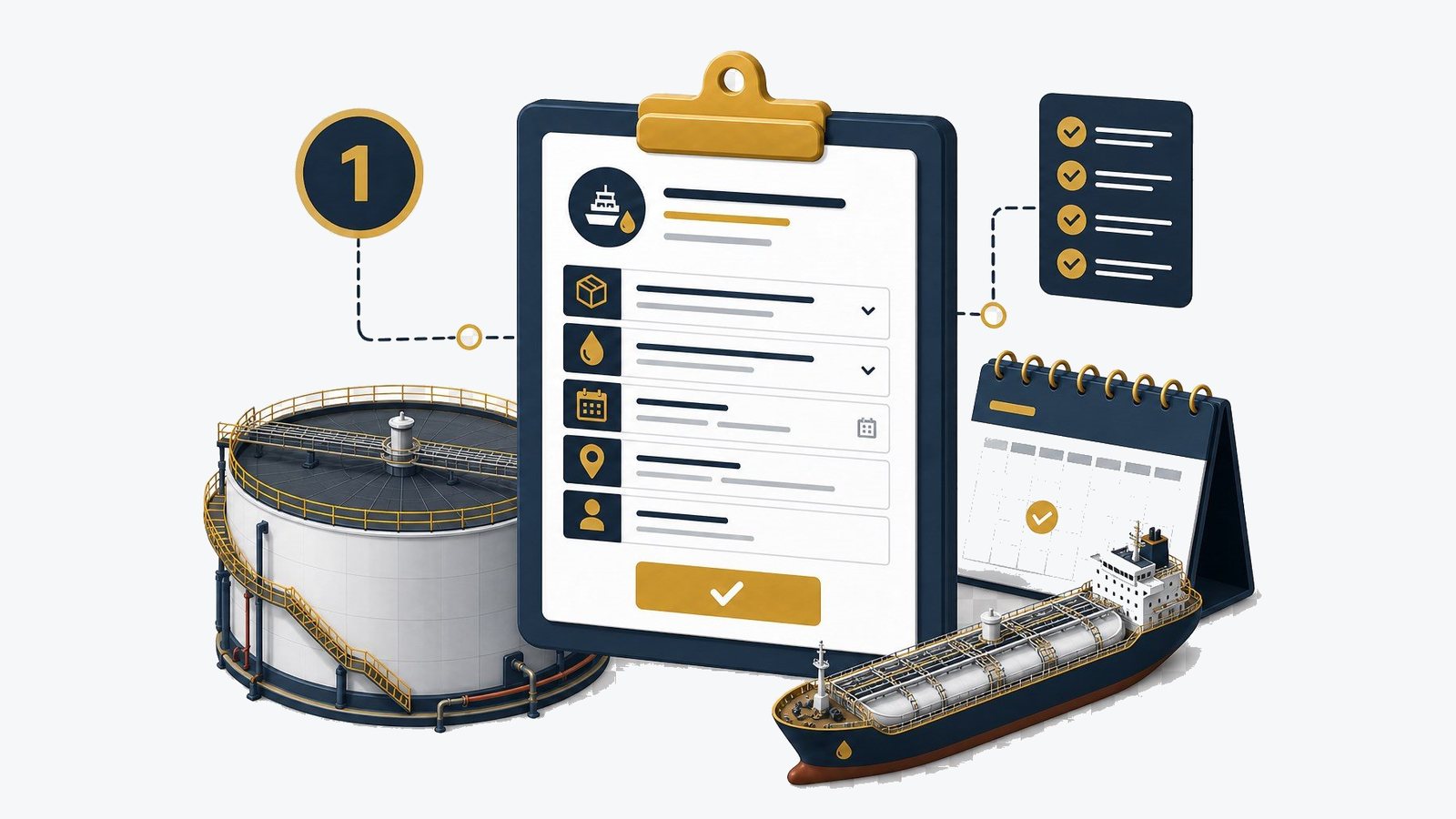
The bulk-liquid trade runs on a compact vocabulary. A single line on a certificate, such as "NSV 491,385 bbl at 60°F", assumes you know what was measured, what was deducted and at what temperature. A clause such as "laytime 72 hours SHINC, reversible" assumes you know when the clock starts. This glossary gives each term a short, exact definition you can rely on.
Definitions follow common industry usage: API MPMS for measurement, standard tanker charter forms for chartering, and the published ISO, ASTM and EN standards for fuels. Where a contract defines a term differently, the contract wins. Where a term is also used in advance-fee fraud, the definition says so plainly, so that you can recognize it out of context.
Words that also appear in fraud
Terms such as TSR, ATV and DTA have genuine uses, but in advance-fee oil fraud they are sold as documents that supposedly prove product exists or grant access to inspect it. A real terminal confirms holdings only to verified counterparties under a signed agreement, and never for an upfront fee.
A
- API gravity
- An inverse density scale for petroleum liquids: 141.5 divided by specific gravity at 60°F, minus 131.5. Fresh water is 10 °API; the higher the number, the lighter the oil.
- API MPMS
- The American Petroleum Institute Manual of Petroleum Measurement Standards, the chapter-by-chapter reference for tank gauging, metering, sampling, temperature, volume correction and marine measurement used in custody transfer.
- ASBATANKVOY
- A tanker voyage charter party form published by the Association of Ship Brokers and Agents (USA), widely used as the base for spot tanker fixtures and usually amended by a rider of additional clauses.
- ATB (articulated tug-barge)
- A tank barge propelled by a tug that sits in a notch at the barge stern and is joined to it by a hinged connection. ATBs are widely used in US coastal trades.
- ATG (automatic tank gauge)
- An instrument, typically servo or radar, that continuously measures the liquid level and often the temperature in a storage tank, for inventory control and overfill protection.
- ATV (authority to verify)
- A document name used heavily in advance-fee oil fraud, where it is sold as permission to check product in a tank. Genuine verification happens between verified parties under a signed agreement, never against an upfront fee.
B
- Backwardation
- A market structure in which prompt prices are higher than forward prices. It rewards selling product now rather than storing it, and usually weakens demand for storage held for price reasons.
- Barrel (bbl)
- The standard US unit of oil volume: 42 US gallons, or about 158.987 liters. Barrels in custody transfer are normally stated at the 60°F standard temperature.
- Bill of lading (B/L)
- The document a carrier issues on loading. It is a receipt for the cargo and evidence of the contract of carriage and, when issued to order, a document of title that controls delivery.
- BS&W (basic sediment and water)
- Water and solids suspended within crude oil or product, determined by laboratory test and deducted as a percentage when moving from gross standard volume to net standard volume.
- Bunkers
- Fuel carried for a ship's own engines and generators, as distinct from cargo. Marine fuels are specified under ISO 8217, and their sulfur content is limited by MARPOL Annex VI.
C
- Charter party (C/P)
- The contract between a shipowner and a charterer for the use of a vessel, whether for a single voyage, for a period of time, or for a series of cargoes.
- Clingage
- Product left as a film on tank walls and internal structures after a shore tank or a ship's tanks are emptied. It contributes to apparent losses between loaded and discharged quantities.
- COA (contract of affreightment)
- An agreement to carry a stated total quantity of cargo over a period in a series of shipments, usually without naming the ships in advance.
- Commingled storage
- Storage in which product of the same specification belonging to several owners shares a tank. Each owner holds a volume entitlement rather than a specific tank. Also called fungible storage.
- Contango
- A market structure in which forward prices are higher than prompt prices. When the spread exceeds the full cost of carry, buying now and storing for later sale becomes profitable, which lifts storage demand.
- Critical zone
- In a floating-roof tank, the level band between the roof resting on its legs and floating freely. Roof displacement is uncertain there, so custody gauges are not normally taken in it.
- Custody transfer
- Any handover of product between parties, or of responsibility for it, at which quantity and quality are measured to an agreed standard as the basis for payment, duties or liability.
D
- Datum plate
- A level plate fixed near the bottom of a tank, directly below the gauge hatch, from which innage measurements are taken and to which the reference height is measured.
- Deadweight (DWT)
- The total weight a ship can carry at its summer load line: cargo, bunkers, fresh water, stores and crew. Tanker size classes such as MR, Aframax and VLCC are defined by it.
- Demurrage
- Liquidated damages a charterer pays the shipowner when loading and discharge take longer than the allowed laytime, at the daily rate stated in the charter party and pro rata for part days.
- Despatch
- Money an owner pays a charterer for finishing cargo operations in less than the allowed laytime. Common in dry-bulk charters and rare in tanker charters.
- DOT-117
- The US tank car specification required for new rail tank cars carrying flammable liquids such as crude oil and ethanol, with a thicker shell, jacket, thermal protection and full-height head shields.
- DTA (dip test authorization)
- A document name common in advance-fee oil fraud, offered as permission to dip-test a tank. Genuine inspections are arranged between verified parties under a signed agreement, with the terminal and an appointed inspector.
E
- ECA (Emission Control Area)
- A sea area designated under MARPOL Annex VI where stricter emission limits apply. In areas designated for sulfur oxides, marine fuel sulfur is capped at 0.10% m/m.
F
- FAME (fatty acid methyl ester)
- Biodiesel made by transesterifying vegetable oils, used cooking oil or animal fats. Specified under EN 14214 in Europe and ASTM D6751 in the US, and blended into diesel.
- Flash point
- The lowest temperature at which a liquid gives off enough vapor to ignite momentarily when a flame is applied under test conditions. It governs storage classification and safe handling.
- Floating roof
- A tank roof that rests on the liquid surface and rises and falls with it, reducing the vapor space and evaporation losses for volatile products such as crude oil and gasoline.
- Free pratique
- Permission from port health authorities for a ship to enter port and for people to embark and disembark. Some charter parties require it before NOR is valid; others do not.
- Free water
- Water lying as a separate layer beneath the product at the bottom of a tank. It is measured at gauging and deducted as a volume before temperature correction.
G
- GOV (gross observed volume)
- Total observed volume less free water and bottom sediment, at observed temperature and pressure, adjusted for shell temperature and any floating-roof correction.
- GSV (gross standard volume)
- Gross observed volume corrected to standard temperature, 60°F or 15°C, using the volume correction factor. It still includes suspended sediment and water.
H
- Heel
- The quantity of product that remains in a tank below the level of the outlet and cannot be pumped out in normal operation. It reduces the working capacity of the tank.
- HVO (hydrotreated vegetable oil)
- Renewable diesel made by hydrotreating fats and oils into paraffinic hydrocarbons. Specified under EN 15940 in Europe and able to meet ASTM D975 in the US.
I
- Incoterms
- Rules published by the International Chamber of Commerce that set out delivery, risk, carriage, insurance and clearance obligations in sale contracts. The current edition is Incoterms 2020.
- Innage
- The depth of liquid in a tank, measured from the datum plate up to the liquid surface. Also called a dip. Innage equals reference height minus ullage.
- ISCC
- International Sustainability and Carbon Certification: a certification system used to document the sustainability and chain of custody of biofuels, renewable feedstocks and related products.
- ITB (integrated tug-barge)
- A tank barge and tug joined by a rigid connection so that they operate as a single unit. ITBs are used mainly in US coastal trades.
J
- Jones Act
- Section 27 of the US Merchant Marine Act of 1920. It requires cargo moving by water between US points to be carried on US-built, US-flagged vessels owned and crewed by US citizens.
L
- Laycan
- Laydays and cancelling: the date window in which a chartered ship must present at the load port. If the ship arrives after the cancelling date, the charterer may cancel the charter.
- Laytime
- The time allowed under a charter party for loading and discharging without additional payment. On tankers it is usually expressed in running hours and is often reversible between ports.
- Letter of indemnity (LOI)
- An indemnity given to a carrier, usually by the receiver, so that cargo can be discharged without the original bill of lading. Common when documents lag behind a short voyage.
- Lightering
- Transferring cargo from a large ship to smaller ones offshore so that the cargo can reach a draft-restricted port. Reverse lightering does the opposite, topping up a large ship from smaller ones.
- Line fill
- The product held in the pipelines between a shore tank and the ship or other receiving point. Its condition, full or empty, must be confirmed before and after every transfer.
M
- Manifold
- The ship's cargo piping connection, usually amidships, where shore hoses or loading arms are attached. Many oil contracts pass risk at the vessel's permanent hose connection there.
- MARPOL Annex VI
- The annex to the IMO MARPOL convention that regulates air pollution from ships, including the 0.50% m/m global limit on fuel sulfur and stricter limits inside Emission Control Areas.
N
- NOR (notice of readiness)
- The master's notice that the ship has arrived and is ready in all respects to load or discharge. Laytime counts from NOR under the rules set in the charter party.
- NSV (net standard volume)
- Gross standard volume less suspended sediment and water. It is the saleable quantity of product at standard temperature and the usual basis for invoicing.
O
- OBQ (on-board quantity)
- Oil, water and residues in a ship's cargo tanks before loading. It is measured by the inspector and taken into account when ship and shore figures are compared.
- Outturn
- The quantity of cargo actually delivered at discharge, as measured into shore tanks or through meters. It is compared with the bill of lading quantity to find transit losses or gains.
P
- Pour point
- The lowest temperature at which an oil still flows under test conditions. Products with high pour points need heated storage and, often, heated or insulated lines.
- Pumping warranty
- An owner's promise about discharge performance, commonly to discharge within 24 hours or maintain 100 psi at the manifold if shore facilities allow. Time lost below the warranty may be deducted from laytime.
Q
- Q88
- The INTERTANKO standard tanker questionnaire setting out a ship's particulars, equipment, certificates and capabilities. Charterers and terminals use it when vetting and accepting nominations.
R
- Reference height
- The fixed vertical distance from a tank's datum plate to the reference point at the gauge hatch. It is checked at each gauge, and innage equals reference height minus ullage.
- Reid vapor pressure (RVP)
- A measure of the volatility of gasoline and crude oil at 100°F. Gasoline RVP limits vary by season and region to control evaporative emissions.
- ROB (remaining on board)
- Cargo, water and residues left in a ship's tanks after discharge. It is measured by the inspector and often forms part of a quantity claim against the ship.
S
- Segregation
- Keeping a product physically separate in its own tanks, lines and pumps so that it is never mixed with other grades or with another owner's product.
- SGS-type inspection
- Trade shorthand for independent third-party inspection of quantity and quality by an inspection company appointed under the contract, which witnesses gauging, draws samples and issues certificates.
- Shell capacity
- The full nominal volume of a tank, from bottom to the top of the shell. Storage is often quoted on it, although working capacity is always smaller.
- SHINC
- Sundays and holidays included: laytime runs every day of the week. Its opposite, SHEX, excludes Sundays and holidays. Tanker charters normally run SHINC.
- SIRE 2.0
- The Oil Companies International Marine Forum's revised Ship Inspection Report Programme, a risk-based inspection regime whose reports underpin tanker vetting by oil companies, charterers and terminals.
- Slops
- Mixtures of oil, water and residues from tank washing and cargo operations, held in a ship's slop tanks or delivered ashore for treatment.
- Statement of facts
- The port record of times and events during a ship's call, signed by the master and the agent. It is the basis for calculating laytime and demurrage.
- Strapping
- Calibration of a storage tank by measuring its circumferences and dimensions at several heights, used to build the capacity table that converts a gauged level into volume.
T
- Take-or-pay
- A contract term under which a customer pays for reserved capacity or a minimum volume whether or not it is used, in exchange for guaranteed availability.
- Throughput
- The volume moved into and out of a terminal or tank over a period. Throughput agreements charge per barrel handled rather than per barrel of capacity reserved.
- TOV (total observed volume)
- The total measured volume of all liquids in a tank, including free water, at observed temperature and pressure, read from the capacity table at the gauged level.
- TSA (Tank Storage Agreement)
- The signed contract between a terminal and its customer that defines tanks or capacity, rates, services, measurement basis and losses. Nothing should be paid or issued before it is signed.
- TSR (tank storage receipt)
- A terminal's acknowledgment that it holds a stated quantity for a named depositor. Fake TSRs offered to unverified buyers are a staple of advance-fee oil fraud.
- Turn
- One full fill-and-empty cycle of a tank. Leases often include a set number of turns per period, with movement beyond them charged as excess throughput.
U
- Ullage
- The empty space above the liquid in a tank, or its measurement from the reference point down to the liquid surface. Also called outage.
V
- VCF (volume correction factor)
- The multiplier that converts a volume at observed temperature to standard temperature, taken from API MPMS Chapter 11.1 using product density and temperature. Also called CTL.
- VEF (vessel experience factor)
- A ship's historic ratio of its own measured quantities to shore figures, used to judge whether ship and shore measurements on a given voyage are consistent.
- Vetting
- The process by which oil companies, charterers and terminals assess a ship's safety and suitability before accepting it, using inspection reports, questionnaires and the operator's record.
W
- Weight in air
- Mass as a weighing in air would register it, slightly lower than weight in vacuum because of air buoyancy. Oil certificates must state which basis they use.
- Working capacity
- The usable volume of a tank: shell capacity less the heel at the bottom and the safety ullage kept free at the top for overfill protection.
- Worldscale
- The Worldwide Tanker Nominal Freight Scale: published flat rates for tanker routes. Freight is negotiated as a percentage of the flat rate, with WS 100 equal to the published rate.
Frequently asked questions
Why are some terms flagged as fraud vocabulary?
Because advance-fee fraudsters borrow genuine terminal language to make fake offers look real. Knowing what a TSR, ATV or DTA would mean in a legitimate operation, and who would ever receive one, makes the fake versions much easier to recognize.
Which standards do the measurement definitions follow?
The American Petroleum Institute Manual of Petroleum Measurement Standards, which most US terminals and inspectors work to. International equivalents use the same concepts, often with 15°C instead of 60°F as the standard temperature.
Can I suggest a term to add?
Yes. Send it through the contact form under the general topic. Terms that our clients ask about more than once are the ones we add first.
Related
Frequently Asked Questions
Storage, freight, tracking, portal access, documents, payments and fraud awareness, answered.
Read more
Custody Transfer, Explained
From TOV to NSV to metric tons: the quantity chain behind every invoice, with a worked example.
Read more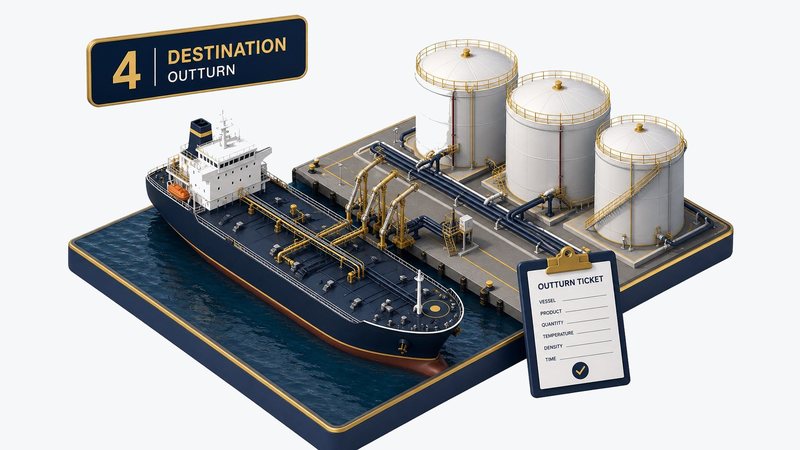
Laytime and Demurrage, Explained
NOR, laytime, demurrage and despatch, with a worked tanker claim using hypothetical figures.
Read moreNeed a term explained in context?
Send us the clause or the certificate line and our team will explain what it means for your cargo.