


Crude Oil Storage
We store crude by grade in floating-roof tanks, keep it mixed and measured, and blend it to the specification your refinery or buyer has set.

Crude oil is not one product. A light sweet grade and a heavy sour grade differ in density, sulfur, vapor pressure, wax and acidity, and each behaves differently in a tank. We store crude by grade, keep each grade on its own tank and line system, and report quantity and quality in the terms crude contracts use: API gravity, sulfur, BS&W and net standard volume.
Our terminal team plans every receipt before the first barrel arrives: which tank, what heel is already in it, whether the grades are compatible, how the vapor space will be controlled and how the tank will be mixed before sampling. That planning keeps a grade on specification and a quantity dispute off your desk.
Grades, gravity and sulfur
API gravity expresses density on an inverted scale: the lighter the crude, the higher the number, and water sits at 10 degrees API. Sulfur content decides whether a crude is sweet or sour, and sour crudes usually bring more dissolved hydrogen sulfide (H2S) into the tank vapor space. Together, gravity and sulfur decide the tank, the vapor controls and the price differential.
| Class | Common definition | What it means in storage |
|---|---|---|
| Light | Above 31.1° API | Higher vapor pressure; floating roof essential; watch evaporation loss |
| Medium | 22.3° to 31.1° API | Standard floating-roof service; mixing keeps wax and sediment moving |
| Heavy | 10° to 22.3° API | Viscous; water and sediment settle slowly; may need heat in cold weather |
| Extra heavy | Below 10° API | Denser than water; usually diluted or heated to move |
| Sweet | Below about 0.5 wt% sulfur | Lower H2S risk, still monitored |
| Sour | Above about 0.5 wt% sulfur | H2S monitoring at every hatch and gauging point |
Floating roofs and tank design
We store crude in floating-roof tanks built to API 650. An external floating roof (Annex C) rides directly on the product, open to the weather, with primary and secondary rim seals closing the gap to the shell. An internal floating roof (Annex H) sits under a fixed roof or dome that keeps out rain and snow. Both shrink the vapor space that drives evaporation loss and air emissions.
A floating roof only works while it floats. When the level drops to the height of the roof legs, the roof lands and a vapor space forms beneath it. We plan draws to keep roofs floating in normal service and treat any landing as a planned event, with emission and safety controls in place.
- Rim seals inspected and gap-measured on a set schedule
- Roof drains checked so rainwater neither sinks a roof nor enters the product
- In-service inspection to API 653 and overfill protection to API 2350
- Secondary containment sized for the largest tank plus rainfall
H2S management
Hydrogen sulfide is heavier than air, numbs the sense of smell at high concentrations and can reach dangerous levels on a gauging platform or at an open hatch. Our crews wear personal H2S monitors, gauge sour tanks from the upwind side and use closed gauging and sampling where the tank allows it. Fixed detectors cover low points where vapor can collect.
Mixing, heel and BS&W
Crude left standing stratifies and drops sediment and wax. Side-entry mixers keep the tank homogeneous, slow the build-up of tank bottoms and make upper, middle and lower samples agree. Sediment that settles anyway becomes part of the heel, the volume below the lowest level the suction can draw. We record heel quantity and ownership at the start of every contract.
Basic sediment and water (BS&W) is measured by centrifuge, and water alone by Karl Fischer titration or distillation, under API MPMS Chapter 10. Free water is drawn off the tank bottom and gauged separately. Many pipeline tariffs cap BS&W at 1 percent or less, so we test before every delivery, not after.
Blending to refinery specification
Refiners buy crude to run a crude unit, not to hold a certificate. We blend grades in tank or inline to targets for API gravity, sulfur, total acid number (TAN), vapor pressure and metals. Specific gravity blends close to linearly by volume and sulfur blends by mass, so we calculate on those bases rather than averaging API gravity numbers.
Adding light crude or condensate to heavy crude causes shrinkage: the blend occupies less volume than its parts. API MPMS Chapter 12.3 sets out the calculation, and we agree the method before blending so shrinkage is not booked as a terminal loss. We also screen paraffinic and asphaltenic crudes for compatibility, because some mixes drop asphaltenes as sludge.
Frequently asked questions
Can two owners' grades go into the same tank?
Only if both owners agree in writing that the result is a new blended grade, with ownership shares set before mixing. Otherwise each grade stays in its own tank and line system, because unplanned mixing changes gravity and sulfur and can shift the value of both parcels.
Who owns the heel?
The storage agreement settles it. At the start of a contract we gauge and record the heel and agree whether it belongs to you, to a previous customer or to the terminal. At the end, heel is bought back, removed during tank cleaning or carried into the next contract.
How do you handle water that settles in the tank?
We find free water with water-finding paste or an interface reading, draw it off to treatment and record the volume. Free water is excluded from gross observed volume, and the water still suspended in the oil is measured as part of BS&W.
Do you heat crude?
Heavy and waxy crudes may need heat to stay pumpable and above their pour point in cold weather. Where the assigned tank has heating, we provide it as a separate service at an agreed set-point, with temperatures logged for the record.
Related
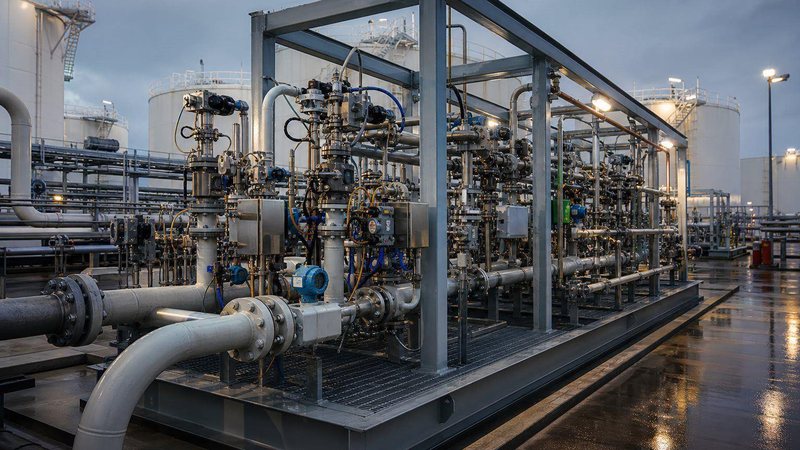
Blending & Additization
In-tank and inline blending and additive injection, verified by ASTM testing before release.
Read more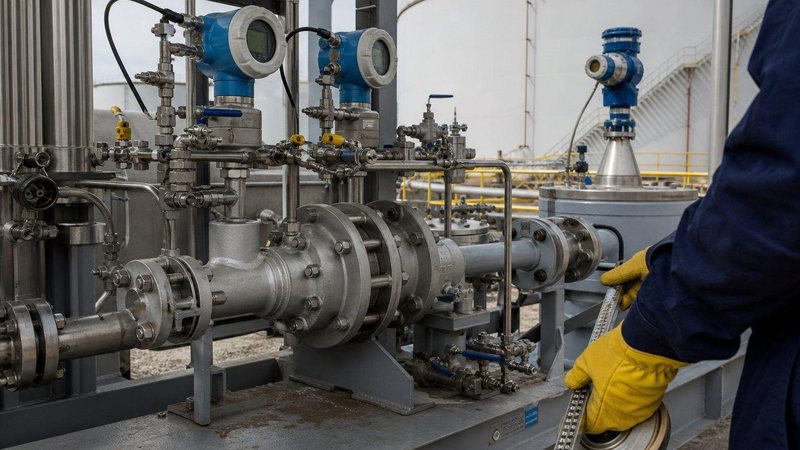
Custody Transfer Measurement
Tank gauging, meters and provers, sampling and volume correction to API MPMS standards.
Read more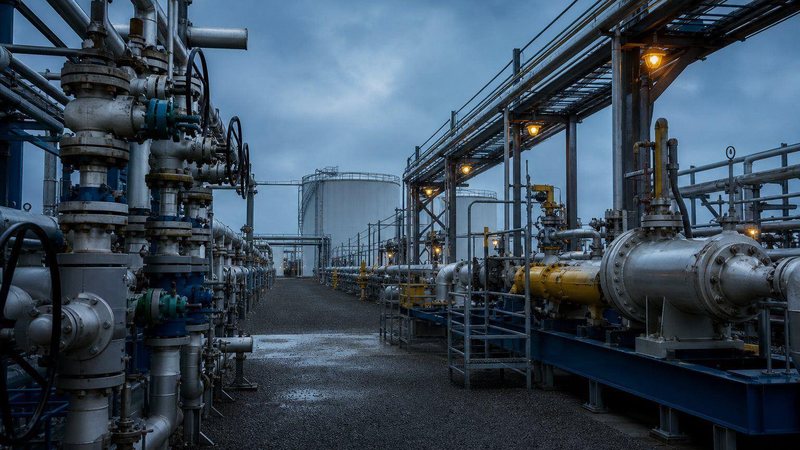
Tank & Line Heating
Steam, thermal oil and heat tracing for viscous products, with logged temperatures and clear pricing.
Read more
Pipeline Shipments
Common-carrier pipelines, FERC tariffs, nominations, batching and metered custody transfer.
Read morePlanning a crude program?
Send the grades, assays, volumes and delivery mode. We will propose tankage, segregation and a blending plan.