


Custody Transfer Measurement
Every barrel accounted for means every figure can be traced: the gauge, the temperature, the sample, the table and the calculation behind it.

Custody transfer is the point where ownership, risk or payment changes hands, and the quantity at that point is what gets invoiced. On a crude or product cargo, a measurement error of a few tenths of a percent can be worth more than the terminal fee. That is why we measure to the American Petroleum Institute Manual of Petroleum Measurement Standards (API MPMS) and keep every reading behind the final figure.
We measure in tanks by gauge and in lines by meter, sample to the same standards, correct volumes to standard temperature and report gross and net quantities in barrels, cubic meters or metric tons as the contract requires. Buyers and sellers can appoint an independent inspector to witness or perform any step.
The API MPMS chapters we work to
Each chapter answers one question: how much does the tank hold at each level, how deep is the liquid, how much passed the meter, how hot was it, what is in it and what does that make at standard conditions. A quantity is only as good as its weakest step, so temperature and sampling get the same discipline as the gauge reading.
| Chapter | Subject | What it governs here |
|---|---|---|
| Ch. 2 | Tank calibration | Strapping and the capacity tables that gauges are read against |
| Ch. 3 | Tank gauging | Manual (3.1A) and automatic (3.1B) gauging of stationary tanks |
| Ch. 4 | Proving systems | Pipe provers, small volume provers and master meters |
| Ch. 5 | Metering | Displacement, turbine, Coriolis and ultrasonic meters |
| Ch. 7 | Temperature determination | Fixed and portable thermometers, averaging probes |
| Ch. 8 | Sampling | Manual tank sampling (8.1) and automatic line sampling (8.2) |
| Ch. 11 | Physical properties data | Volume correction factors for temperature and pressure |
| Ch. 12 | Calculation of quantities | Static (tank) and dynamic (meter) calculations |
Automatic or manual gauging
An automatic tank gauge (ATG), usually radar or servo, reads level continuously and feeds inventory systems and level alarms. Manual gauging with a calibrated tape and bob, under API MPMS Chapter 3.1A, remains the reference method, and many contracts still require it at custody transfer. We use ATGs for operations and check them against manual gauges on a set schedule.
Gauges are taken as innage, the depth of liquid above the datum plate, or ullage, the empty space from the reference point down to the liquid surface. Free water at the bottom is found with water-finding paste or an interface probe. Readings are repeated until they agree within the tolerance the standard sets.
From gauge to net standard volume
Petroleum expands as it warms, so an observed volume means little until it is corrected to standard temperature: 60 °F in US practice, 15 °C in most other markets. API MPMS Chapter 12.1 sets the sequence shown in the steps below. For clean products, gross and net standard volume are usually the same; crude is invoiced on net standard volume, after sediment and water are deducted.
Barrels and metric tons
US trade quotes barrels; much international trade quotes metric tons. The conversion depends on density, so each cargo is converted from its own measured density through the standard tables, never from a rule of thumb. The averages below are for planning only. For example, 50,000 MT of Jet A-1 is roughly 394,000 barrels at a typical jet density.
| Product | Approx. barrels per metric ton |
|---|---|
| Crude oil (average) | 7.33 |
| Gasoline | 8.53 |
| Jet fuel and kerosene | 7.88 |
| Diesel and gas oil | 7.46 |
| Residual fuel oil | 6.66 |
| LPG | 11.6 |
Meters, provers and independent inspection
Pipeline and rack movements are measured by custody meters under API MPMS Chapter 5 and proved under Chapter 4 to set a meter factor. Proving frequency and acceptance limits are agreed by contract. Automatic samplers under Chapter 8.2 take a flow-proportional sample through the whole transfer, so the sample represents the whole parcel.
Either party may appoint an independent inspection company, of the kind buyers commonly use such as SGS, Intertek or Bureau Veritas, to witness or perform gauging, sampling and calculation. We give the appointed inspector access, calibration tables, meter and prover records and retained samples. Where shore and ship figures differ, the vessel experience factor under Chapter 17.9 helps explain the gap.
How it works
- 1Total observed volume
Read the volume at the gauged level from the tank capacity table.
- 2Gross observed volume
Deduct free water; correct for shell temperature and any floating-roof adjustment.
- 3Gross standard volume
Apply the Chapter 11.1 correction factor to bring the volume to standard temperature.
- 4Net standard volume
Deduct the sediment and water measured in the sample.
- 5Mass
Convert to metric or long tons from density at standard conditions and the weight tables.
Frequently asked questions
Which figure goes on my storage receipt?
The quantity in the unit and basis your agreement specifies, usually gross or net standard volume in barrels at 60 °F, with metric tons where required, plus the gauges, temperatures and quality data behind it. Receipts are issued only to KYC-verified counterparties.
Why do shore and ship figures differ?
Ship tanks are calibrated less precisely than shore tanks, lines may not be completely full, and clingage and quantities remaining on board vary. The vessel experience factor adjusts ship figures using that ship's history of differences against shore figures.
Is weight in air different from weight in vacuum?
Yes. Commercial weights are usually stated in air, slightly below the true mass in vacuum because of air buoyancy. The standard tables convert density to weight in air by deducting about 1.1 kg per cubic meter. The contract should say which basis applies.
Can I see my allocation online?
KYC-verified buyers and receipt holders see their product allocation in the Buyer / Receipt-Holder Portal. Gauge records, quality certificates and inspection reports are provided to the owner as the storage agreement sets out.
Related

Custody Transfer, Explained
From TOV to NSV to metric tons: the quantity chain behind every invoice, with a worked example.
Read more
Tank Gauging: Reading the Numbers
Innage, ullage, ATG and manual gauges, and a worked opening and closing gauge report.
Read more
Buyer / Receipt-Holder Portal
KYC-verified buyers see grade, quantity, tank, status and documents for the product they hold.
Read more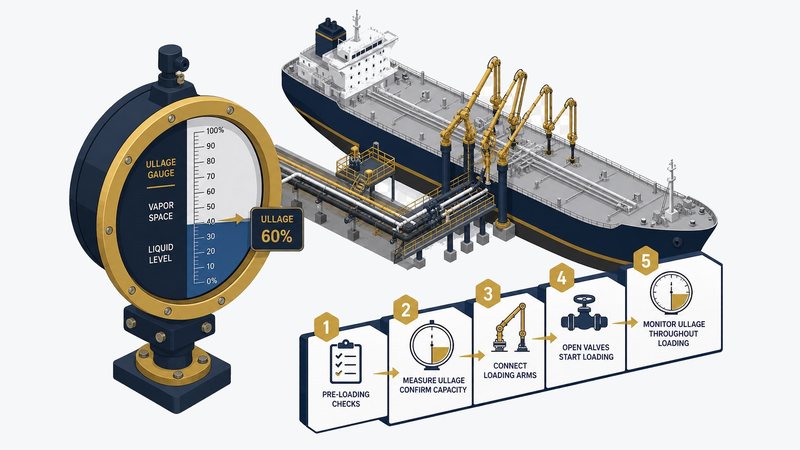
Throughput Agreements
Throughput fees, take-or-pay, excess throughput and the nomination cycle explained.
Read moreNeed measurement you can audit?
Tell us the products, the transfer points and the inspection terms in your contract. We will set out how we measure.