Short, evergreen explanations of the forces that shape storage, freight and cargo risk. No dates, no prices and no market calls, just the mechanics that stay true as markets move.
These briefings explain topics that come up again and again in conversations between terminals, traders, charterers and cargo buyers. Each one takes a single idea, such as why storage demand follows the forward curve or why a discharge figure never quite matches the bill of lading, and sets out the mechanics in a few paragraphs.
They are written to stay accurate. You will find no dates, no prices and no forecasts here, because those belong in a market report rather than a reference page. Where a briefing touches a subject covered in depth elsewhere in this section, the related guides take the explanation further, with tables and worked examples.
How to use the briefings
Read a briefing before a meeting, share one with a colleague who is new to the trade, or use one as a checklist when a figure or a document does not look right. Each is self-contained. If a briefing raises a question about your own cargo or contract, our desk will answer it against your documents.
Storage markets
What contango means for storage demand
When forward prices sit above prompt prices, holding oil can pay for itself. Here is how the curve drives tank demand, and where the trade breaks down.
Read the briefing
In a contango market, oil for later delivery is priced above oil for prompt delivery. A trader who buys a prompt cargo and sells it forward locks in the spread, and if that spread is larger than the full cost of holding the barrels, storage becomes a profitable trade in its own right. That is why tank demand rises when curves move into contango, and why tanks near the main trading hubs tend to fill first.
The full cost of carry is more than tank rent. It includes financing the cargo value, insurance, inspection, handling, heating for some grades, and an allowance for measurement losses. Because financing is a large share of the total, higher interest rates need a steeper contango before storage pays. Term leases signed during a shallow contango can look expensive if the curve flattens, which is why traders weigh tenor as carefully as rate.
Backwardation reverses the logic. When prompt barrels are worth more than forward barrels, the market rewards holders for releasing product, and storage held for price reasons empties. Terminals do not go quiet in backwardation, though. Operational storage, the tanks that support refinery runs, blending, distribution and import schedules, keeps working whatever the shape of the curve.
Measurement
Why outturn rarely matches the bill of lading
A small difference between load-port and discharge figures is normal. Knowing where it comes from tells you when a gap becomes a claim.
Read the briefing
The bill of lading quantity is fixed at the load port, usually from shore-tank or meter figures. The outturn is measured into shore tanks at discharge, days or weeks later, by different people with different equipment and different capacity tables. Expecting the two numbers to match exactly is like expecting two separate weighbridges to agree to the kilogram. Some difference is a feature of measurement, not evidence of theft.
The usual contributors are well understood: clingage left on tank and pipe walls, cargo remaining on board after discharge, line fill assumed full that was partly empty, temperatures taken at too few levels, water that separated during the voyage, and the uncertainty in each tank's calibration. Inspectors use ship figures, OBQ, ROB and the vessel experience factor to show at which end of the voyage a difference most likely arose.
A gap becomes a claim when it exceeds the tolerance in the contract and the documents support it. That requires the same measurement basis at both ends, signed gauge reports, timely written protests and the inspector's voyage analysis. Buyers who check the basis of each figure before signing anything hold far stronger claims than those who argue from the bottom line alone.
Renewables
Renewable diesel and SAF: what changes in the tank
Renewable fuels look like familiar products on paper. In storage, handling discipline and documentation make the difference.
Read the briefing
Renewable diesel, made by hydrotreating fats and oils, is a paraffinic hydrocarbon that stores much like fossil diesel. FAME biodiesel is chemically different: it is an ester that attracts water, can degrade through oxidation and may cloud or gel at temperatures fossil diesel tolerates. Sustainable aviation fuel components follow their own path through ASTM D7566 before blending with conventional jet. Each product brings its own storage discipline.
The larger change is in the paperwork. Renewable fuels are often valued for their sustainability attributes as much as for their physical properties, and those attributes depend on an unbroken chain of custody under schemes such as ISCC. A terminal storing them must keep segregation, mass-balance records and documentation that survive an audit, not just tanks that keep the product on specification.
Practical consequences follow. Tanks may need dedicated service or careful cleaning between grades, blending must be metered and recorded precisely, and SAF blends need certification and recertification as jet fuel before release. For buyers, the question to ask any terminal is not only whether it can hold the product, but whether it can prove what the product is and where it came from.
Chartering
How vetting shapes which ships you can fix
The right size and the right rate are not enough. A tanker must also clear vetting before most charterers and terminals will accept it.
Read the briefing
Vetting is the process by which oil companies, charterers and terminals decide whether a ship is acceptable for their cargo or their berth. It grew out of hard lessons on safety and pollution, and today it is a gate every tanker must pass. A ship that is open, competitively priced and the right size can still be unusable if its vetting status will not satisfy the receiver, the load terminal or the charterer's own policy.
The main inputs are the ship's Q88 questionnaire, which records its particulars and equipment, and inspection reports under OCIMF's SIRE 2.0 regime, which look closely at how the ship and its crew actually operate. Vetting teams also weigh the operator's management standards, recent incidents, port state control history and feedback from terminals that have handled the ship.
For cargo owners the lesson is to involve vetting early. Name the terminals and receivers at the inquiry stage, check their acceptance criteria, and allow time for review before fixing. A rejected nomination after the ship has sailed costs far more than a day spent confirming acceptance before the charter party is signed.
Terminal operations
Reading a tank-gauge report in five minutes
A gauge report is the raw material of every shore-tank quantity certificate. A few checks tell you whether to trust it.
Read the briefing
Start at the top: the tank number, the date and time of each gauge, and the names of the people who witnessed it. Opening and closing gauges should be on the same tank, at the same gauge point, by the same method, and the tank should have been isolated between them with its valves sealed. If any of those basics is missing, everything below is open to challenge.
Next, read the measurements. Look for the observed reference height and whether it matches the tank's certified figure, the level reading itself, the free water at the bottom, and temperatures taken at enough levels for the depth of liquid. For floating-roof tanks, check that the roof was floating freely at both gauges and not resting in its critical zone.
Finally, follow the arithmetic. Total observed volume comes from the capacity table; deducting free water gives gross observed volume; the volume correction factor brings it to standard temperature; deducting sediment and water gives net standard volume. Each step should name the table or method used. A report that cannot be traced through those steps is a number, not a measurement.
Fraud awareness
Spotting oil-trade document fraud
Advance-fee fraud borrows the vocabulary of real terminals. The pattern is consistent, and so are the defenses.
Read the briefing
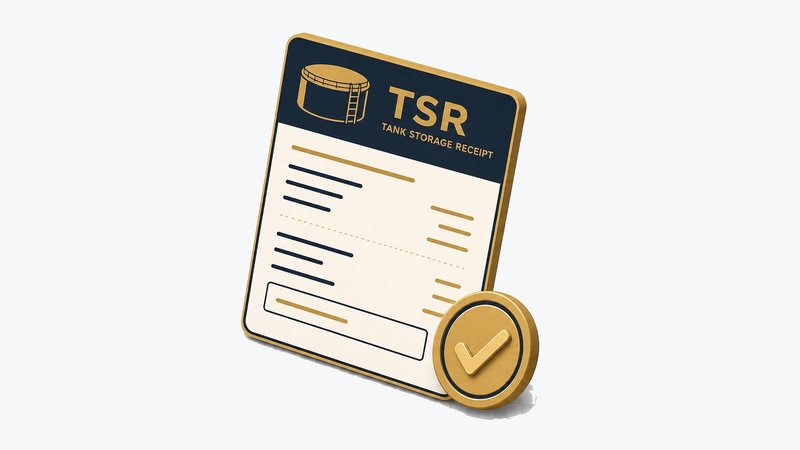
Oil-trade fraud usually follows a script. A seller offers product at an attractive discount, claims it already sits in a named terminal, and offers documents to prove it: a tank storage receipt, an authority to verify, a dip test authorization. Before the buyer can see the product, there is a fee to pay, to reserve the tank, to cover inspection or to release the paperwork. The product never existed, and the fee is the point.
The defenses are simple. Genuine terminals verify counterparties before releasing anything, issue storage documents only to verified depositors under a signed agreement, and never charge a third party to reserve or inspect a tank. Confirm any claim directly with the terminal, using contact details from its own website rather than from the documents you were sent, and never pay an account that is not named in a signed contract.
Learn the warning signs: documents offered before KYC, pressure to act within hours, free email addresses, letterheads with small errors, and procedures that put every cost on the buyer before any product moves. CorEnergy never issues storage receipts to unverified counterparties and never asks for pre-payment to reserve or inspect a tank without a signed Tank Storage Agreement. If something claiming to come from us looks wrong, call +1 252 633 7061.
Frequently asked questions
Why do the briefings carry no dates or prices?
Because they explain mechanics that hold true in any market. Prices, spreads and freight levels change daily and belong in a market report. Keeping the briefings evergreen means they stay accurate whenever you read them.
Can I share a briefing with my team or clients?
Yes. Share the page link freely. The briefings are written for anyone who buys, stores, ships or finances bulk liquids, from experienced traders to colleagues new to the trade.
Can you brief us on a topic in more depth?
Yes. Tell us the subject and the questions your team is working through, and our terminal or chartering specialists will set up a call to go through it against your own cargoes and contracts.